Last Updated on September 21, 2026 by Umar Farooq
Use the wool cycle if your machine has one, or cold water on delicates if it does not. Wool detergent, garment inside out or in a mesh bag, and the lowest spin available. Then press the water out in a towel and dry flat, never on a hanger. Hand washing is lukewarm water, a ten-minute soak, and no rubbing or wringing at any point.
The reason all of that matters is felting, and felting is the one laundry accident with no repair. Woolmark’s own wording is that the process “is irreversible and leads to fibre entanglement, fabric densification or garment shrinkage” — the mechanism is set out in why do clothes shrink in the wash. Everything below exists to keep the three ingredients of felting — heat, moisture and agitation — from arriving together.
How to wash a wool sweater in the machine
Often you can, and the care label decides. Woolmark’s instruction is short: “Turn your wool sweater inside out, or use a laundry bag”, “Add a wool detergent, preferably a Woolmark-approved detergent”, and “Set your cycle to the wool setting” (how to wash a wool sweater).
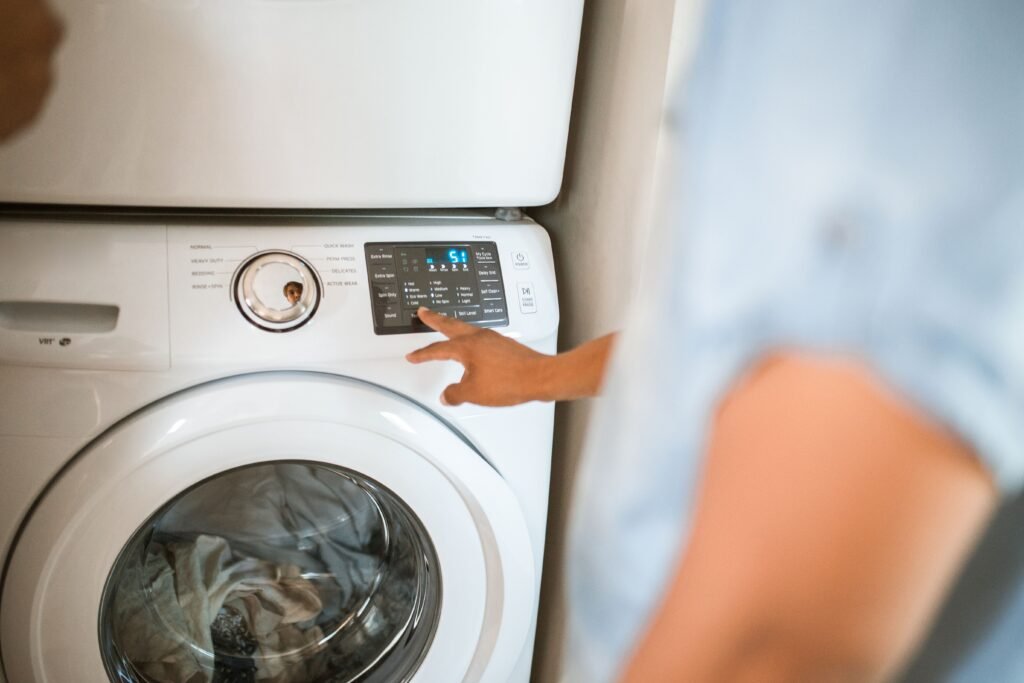
What nobody explains is what that setting actually does, which matters enormously if your machine does not have one. A wool cycle is not simply a cold delicate wash. It is a drum rhythm: long soaking pauses with brief, slow rotations in between, so the garment is moved as little as possible while still being cleaned. Agitation is the ingredient the cycle is engineered to remove.
Woolmark names that substitute too: “If your washing machine does not have a wool cycle, then it is recommended to use the cold water wash or wash cycle for delicates.” Turn the spin down as well — the spin is agitation that happens after the wash, and most wool cycles already limit it for that reason.
One label check settles it before any of this. A tub symbol with a double bar underneath is the very mild cycle intended for woollens; a single bar is ordinary mild. The full set is in laundry symbols.
The temperature question, where Woolmark contradicts itself
This is worth showing rather than tidying away, because both figures come from the same organisation.
Woolmark’s washing-symbols page says to “hand wash at a water temperature between 30°C and a maximum of 40°C, depending on the particular article.” Its how-to-wash-wool page says lukewarm, “approximately 30°C”. For machine washing it describes the wool setting as “usually gentle action at 40°C”.
Take 30 °C. It sits inside every one of those statements, no source anywhere argues that wool needs to be warmer, and heat is one of the three things felting requires. When the authority gives you a band, the bottom of the band is free.
How to hand wash a wool sweater, step by step
- Dissolve the detergent first, before the sweater goes in. Woolmark is specific: “First dissolve a fine wool detergent in plenty of water.” Neat detergent landing on wet wool is a stain risk.
- Turn it inside out and submerge it. Let it float rather than pushing it under.
- Soak ten minutes. That is Woolmark’s figure, and it is long enough. A longer soak does not clean better; it just gives the fibres more time in water.
- Do not rub, pull or wring. Their phrasing exactly. Rubbing is hand-powered agitation and it felts just as effectively as a drum.
- Rinse twice — lukewarm, then cold. Then “press the superfluous water out carefully before pulling the item into shape.”
The general technique carries across to other delicates: how to hand wash clothes.
Drying is where the shape is won or lost
More sweaters are ruined here than in the wash, and the failure is not shrinkage — it is the opposite.
Woolmark explains why a hanger is wrong: “Line drying or drying on hangers can cause knitted garments to stretch due to the weight of the moisture contained by the garment, with the result that the garment grows in length and loses its shape.” It gets more specific about hangers, too — they “can cause distortions to appear in the form of humps on the shoulders of the garment” (how to dry a wool sweater).
So: roll it in a towel, press, then lay it flat on a second towel — “a pale coloured or white towel, and one which is free from lint” — and reshape it by hand while damp. Out of direct sunlight.
And the myth worth correcting. Every guide says never tumble dry wool. Woolmark does not: “Certain wool garments can safely be dried in a tumble dryer without the item shrinking. Woolmark-approved garments that have a care claim that states ‘tumble dry’ can be tumble dried on a low heat setting or a setting for wool or delicates.” That is a narrow permission resting entirely on the label — but if your sweater carries that claim, the blanket ban you have read everywhere is not the manufacturer’s position.
Wash it far less than you think
The best wool care is mostly not washing. Wool resists odour naturally, so unless a sweater is visibly dirty or actually smells, airing it overnight does the job.
Dale of Norway builds its whole guidance around this, leading with “wash less, air more” and spot-cleaning before any full wash (care instructions). Every wash is another pass through the heat-moisture-agitation window, and the garment only has so many of those in it.
For a spill, treat the spot rather than the sweater. Blot — do not rub, for the same reason you do not rub in the wash — and use cool water with a little wool detergent on that area alone. Two cautions carry over from elsewhere on this site: never bleach wool, which Clorox lists among the fibres to avoid entirely, and keep biological detergents away from it, because enzymes that break down protein do not distinguish between a stain and the fibre.
Pilling is not a fault, and it is not a washing mistake
Those little fuzzy balls appear after a few wears and people assume they bought badly or washed wrongly. Neither is usually true.
Woolmark defines them plainly — “the formation of fuzzy balls on the surface of wool clothing” — and names the cause as friction during wear rather than laundering: “Pilling is caused by rubbing during wear”, concentrated “around the elbows, armpits, sleeves, belly and the sides of the sweater.” Their honest line on predicting it: “Because pilling is so complex, nobody can guarantee that it won’t occur” (what is pilling).
Removal is easy and worth doing before a wash rather than after, so the pills do not work themselves deeper into the surface. Pick them off by hand if there are few, comb gently if there are more, or use a battery fabric shaver — Woolmark calls these “low cost and very effective at removing pills.” What you should not do is pull a pill hard enough to take a loop of yarn with it.
Storing it so the next wash is not needed
Fold, never hang. A knitted garment on a hanger stretches under its own weight in a wardrobe exactly as it does on a drying line, and shoulder humps are the result either way.
Store clean, because moths are attracted to the traces a worn garment carries rather than to the wool itself, and a sweater put away with a food or sweat mark is the one that gets eaten. Give it a breathable box or bag instead of sealed plastic — wool holds moisture, and sealed plastic keeps it there.
FAQ
Can you machine wash a wool sweater?
Usually, on the wool cycle with wool detergent and a low spin, provided the care label allows it. Cold delicates is the substitute if there is no wool setting.
What temperature should you wash wool at?
30 °C. Woolmark’s own pages give 30 °C in one place and up to 40 °C in another, and nothing is gained by taking the warmer end.
Can you put a wool sweater in the dryer?
Only if the label carries a tumble-dry claim, and then on low or the wool setting. Otherwise dry it flat.
Why did my wool sweater shrink?
Felting — heat, moisture and agitation together lock the fibre scales into each other. It is irreversible, which is why the precautions are worth taking.
Can you use normal detergent on wool?
Better not to. Wool is a protein fibre and biological detergents contain enzymes that digest protein. Use a wool-specific detergent.
How often should you wash a wool sweater?
When it is dirty or smells, and rarely otherwise. Airing between wears replaces most washes.
The honest verdict
Cold, gentle, low spin, flat to dry — and then leave it alone for a few wears. Wool asks for less handling than almost anything else in the wash basket, and the mistakes that finish a sweater are all things people did with good intentions.