Last Updated on September 22, 2026 by Umar Farooq
If your dryer won’t turn on, the useful question is not what is broken. It is how far it got. A machine with no lights at all has a supply problem. A machine with a lit panel that ignores Start has an interlock or a lock refusing to release. A machine that starts and dies two seconds later has something detecting a condition and pulling out. Three stages, three completely different shortlists, and telling them apart costs nothing.
Most dryers that “won’t work” are refusing rather than failing. The control has decided a condition is not met — the door never confirmed latched, the panel is locked, one leg of a 240-volt circuit is dead — and is declining to proceed. That is a safety system doing its job. It is also, conveniently, the cheapest category of fault there is.
Stage one: the dryer won’t turn on at all, no lights, no sound
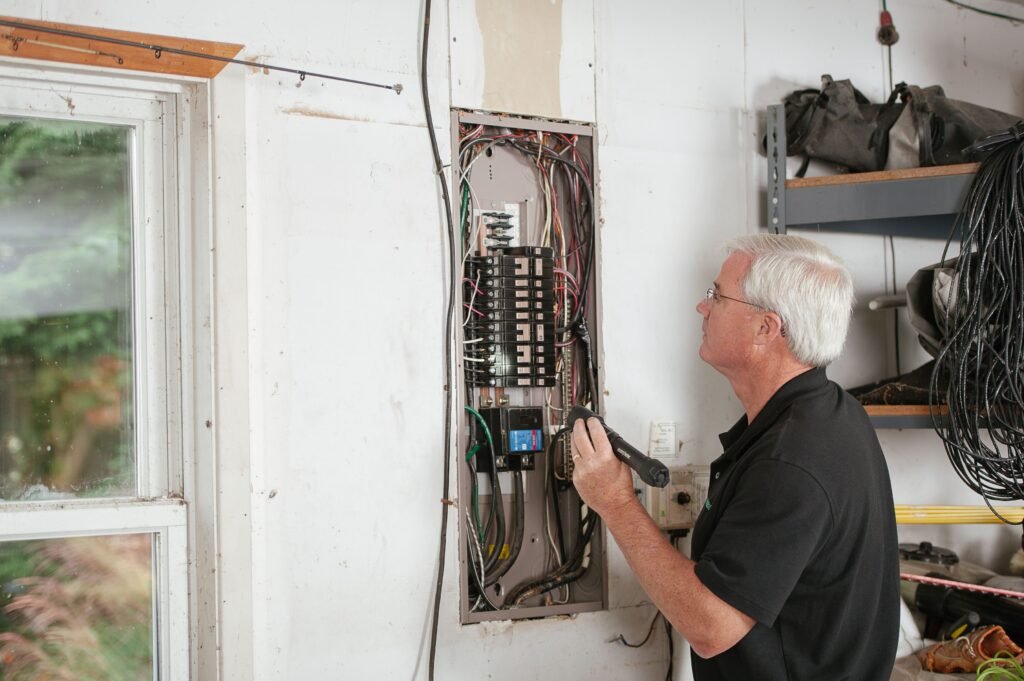
A dead panel means power is not arriving, and there is a free test before you touch anything. Samsung publishes it: “If your model has a drum light, and it comes on when you open the door, you can skip checking the outlet since the drum light confirms that the outlet is working” (Samsung, dryer loses power or won’t turn on). Open the door. If the drum lights up, the supply is fine and you can skip everything in this section.
If it does not, go to the panel rather than the plug. Electric dryers run on two-part 240-volt circuits, and Samsung flags the failure mode nobody spots: “In rare cases, the circuit is ‘half-tripped.’ Power off both circuits for 30 seconds and then back on to correct this.” A half-tripped breaker looks armed. Switch it fully off, wait, switch it fully on — because, as Samsung puts it, “a tripped circuit can be hard to spot.”
Gas dryers are simpler. “Gas dryers need a 15 Amp circuit (and use a regular 3-prong outlet)”, so a lamp in the same socket settles it in ten seconds. And before any of that, Samsung’s first line on the page: “Always switch off the circuit breaker before interacting with the dryer’s power cord.”
Stage two: the panel lights but Start does nothing
This is the most common version, and it is almost never a broken part. A lit panel proves the supply, the cord, the control board and the display are all fine. What is left is a short list of refusals.
Start with the button, because Maytag’s own instruction catches a surprising number of people: press “Start,” “Push to Start” or “Hold to Start” firmly “for approximately two to five seconds, depending on your model,” since “Simply tapping the ‘Start’ button may not allow enough time for the appliance to engage the motor.” On a touch panel, Maytag adds: “be sure to press the button with a dry finger, as moisture or pressing with a fingernail can cause the panel to be unresponsive” (Maytag).
Then Child Lock, the single most common non-fault on this search. Samsung is blunt: “If your dryer won’t start, the buttons won’t work, or the control knob won’t select a different cycle, you probably have Child Lock turned on. If your Child Lock icon is lit, this confirms it” (Samsung, control buttons do not respond). It clears with a two-button hold — Samsung names “Temp and Time, or Dry Level and Temp” as common pairs, hedges that “the exact buttons will vary between models,” and says hold three seconds or more. The washer equivalent is at washer control lock.
Then the door. Push it firmly until it clicks. Maytag notes a dryer “may have one or two latches depending on the model, but all must be engaged for the dryer to operate,” and warns about what you cannot see from the front: “be sure that clothing items aren’t stuck between the body of the dryer and the door during loading.” A sleeve in the seal holds the switch open by a millimetre, and a millimetre is enough.
Stage three: it starts, then stops within seconds
A dryer that begins to tumble and then quits has already proved the motor circuit, the door switch at the moment of pressing, and the control. Something is detecting a condition afterwards and withdrawing.
The one nobody suspects is the vent. Samsung records it explicitly: “In some situations, as a safety measure, the dryer may shut itself off if a blockage is detected in the vent. This will appear like the dryer suddenly turned off or lost power.” Read that twice: a blocked duct can present as an electrical fault with no heat symptom at all. Samsung also notes the limitation — “If your dryer won’t turn on at all, you can’t run a vent blockage test.”
A door switch losing contact under vibration produces the same pattern, and so does a thermal fuse opening as the circuit warms. If the drum is also making a new noise, the belt or a roller may be involved rather than the electrics — dryer not spinning covers that side.
Samsung’s stop-list, and three more you can see
Samsung publishes a genuinely useful stop-list, worth quoting because it names conditions rather than giving a vague warning. “Stop troubleshooting and contact an electrician if: You see any burn marks or damage. / The dryer has never heated since it was installed in this location… / The installation of an electric dryer’s power cord is visibly incorrect or loose.” Its reasoning: those “do not indicate that the dryer is the cause of the issue.”
Three more you can confirm by looking. A breaker that trips again as soon as the dryer runs — leave it off, call an electrician. Any smell of burning at the cabinet or outlet — cut power and do not run it again. And a dryer dead since the day it was moved, which points at the installation. The washer version of this sequence, including GFCI outlets and failed surge protectors, is at washing machine won’t turn on.
FAQ
Is there a reset button on a dryer?
Some models have one; most do not. The universal equivalent is a power cycle, and Samsung publishes different waits for different situations — 30 seconds at the breaker to confirm a trip, 60 seconds unplugged for an unresponsive panel. A reset clears a state. It does not repair anything.
Why does my dryer hum but not start?
A hum means the motor has power and is trying to turn, which rules out the supply, the door switch and the control. Usually a seized bearing, a jammed blower wheel or a failed start winding. Stop pressing Start — a stalled motor draws heavily and gets hot fast.
Can a blown thermal fuse stop a dryer turning on completely?
Yes, on models where the fuse sits in the motor circuit rather than the heating circuit: a dead machine with a live outlet. It is a one-time device, so it blew because something restricted the airflow, and the vent needs clearing before a new one goes in.
My dryer worked yesterday and is dead today. What changed?
Usually the supply, not the dryer. Check for a half-tripped breaker first, then for anything that moved the machine — a push back against the wall can crush a duct or strain the cord.
Does Child Lock switch itself on?
It gets switched on accidentally more often than people admit, usually by leaning on the panel or wiping it down. Samsung notes the icon varies: “the Child Lock icon may look like a baby or a lock with a smiley face.” Look for a lit icon before assuming a fault.
Should I test the outlet with a multimeter?
Not on an electric dryer. That is a 240-volt socket, and Samsung’s guidance is that “electric dryers use a different type of outlet that isn’t as easy to test.” Use the drum-light test, and hand the outlet to an electrician if it is still in doubt.
Power first, controls second
Work the stages, not the parts list. A drum light that comes on takes the whole power section off the table in two seconds. A lit panel that ignores Start is Child Lock, a button not held long enough, or a door that never confirmed — three checks, no tools, no parts. Only a machine that starts and then withdraws is genuinely detecting something, and even then the first suspect is a blocked vent, not a failed board.
The part most often replaced on this symptom is the one the previous stage already proved was working.