Last Updated on October 5, 2026 by Umar Farooq
A Maytag dryer not heating is, nine times in ten, a healthy machine with its heat supply interrupted — one leg of the 240 V circuit, a closed gas valve, a power cord terminal that was never tightened, or a safety device that a blocked vent took out. The tumble system and the heat system are independent, and yours is already proving half the machine works. Maytag states the separation outright: “The drum of your dryer and its heating element are separate, so it is possible for your dryer to spin but not heat your clothing—the two are not necessarily related.”
Maytag, Whirlpool, Amana and Kenmore 110 are one platform wearing four badges, so the mechanics here are not Maytag’s alone. What is Maytag’s own is the wording, the display behaviour and the procedures published under the badge — and those differ from Whirlpool’s in ways that matter when you are standing in front of the machine. This page works through Maytag’s four relevant support pages and says where each one stops. For the heating-element mechanism itself, the brand-agnostic version is dryer not heating.
Maytag’s heat test asks for five minutes and an empty drum
Every page on this search tells you to feel inside the dryer. Maytag is more precise than that, and the two details it adds are the ones that stop a false result. Maytag’s own instruction reads: “To test if the dryer is heating: 1. Select a heated timed cycle 2. Run the cycle for 5 minutes (empty dryer). 3. Open the door and feel inside.”
A timed cycle, because an automatic cycle reads moisture and is entitled to withhold heat. An empty drum, because damp laundry absorbs exactly the warmth your hand is looking for. Five minutes rather than thirty seconds, because Maytag’s figure is Maytag’s — Samsung asks for thirty seconds on its own machines, and neither brand is wrong about the other’s dryer. Use the number that belongs to the badge in front of you.
Rule out the free explanation before the test even starts. Maytag publishes it flatly: “The Air Only cycle or Air/Fluff Only does not add heat to the dryer at any time during the cycle.” A dryer obeying the button you pressed is not a fault, and this accounts for more of these searches than anybody admits. Maytag adds that air-only cycles “work better when using a Timed Dry cycle” — which is a quiet hint that the no-heat behaviour is deliberate, not a side effect.
The display on a Maytag dryer not heating: AF, Check Vent, L2 and PF
Maytag’s published dryer code list is four codes plus one catch-all, and that brevity is the useful part. Two of the four are about heat, and both of them let the dryer keep running — which is precisely how a restricted vent goes unnoticed for a year while the clothes come out warm and damp.
AF is restricted airflow. Maytag’s wording: it “indicates that the lint screen or vent is clogged; the vent is crushed, kinked or has too many turns. The dryer will continue to run when the is error is present.” (The transposition in that sentence is on Maytag’s live page, not a typo at this end.) Maytag then adds a detail Whirlpool’s copy omits: “Touch any key to clear the code from the display and return to the estimated time remaining.” A code you can dismiss with one touch is a code people dismiss.
| What the display shows | What Maytag says it means |
|---|---|
AF or F4E3, or a Check Vent light | Restricted airflow — lint screen or vent clogged, crushed, kinked, or too many turns |
L2 | “Low or no line voltage… keeping the dryer’s heater from turning on.” Shows only during initial installation |
PF | Power failure — the cycle was interrupted |
F# E# | “the dryer control has detected a problem that requires service” |
The Check Vent light is the Maytag detail worth knowing, because it is not a code at all. Maytag’s long-dry-times page describes the same condition as “An AF (Restricted Air Flow) or ‘Check Vent’ error code” — so on a model without an alphanumeric display, the identical fault arrives as a named indicator lamp. If that lamp is on and your clothes are cold, the vent is the first and possibly the only thing to deal with.
L2 deserves its own note, because Maytag restricts it to “the initial installation.” That is a pointer away from the dryer and toward the install: the cord, the outlet, the supply. And Maytag’s remedy is more specific than Whirlpool’s version of the same code, naming the fuse case explicitly: “Check if a household fuse has blown or the circuit breaker has tripped. Electric dryers use two household fuses or breakers. Replace the fuse or reset the circuit breaker.” Then: “Select a Timed Dry heated cycle and restart the dryer. If the message persists, consult a qualified electrician.”
Two breakers, two fuses, and one of them is usually the answer
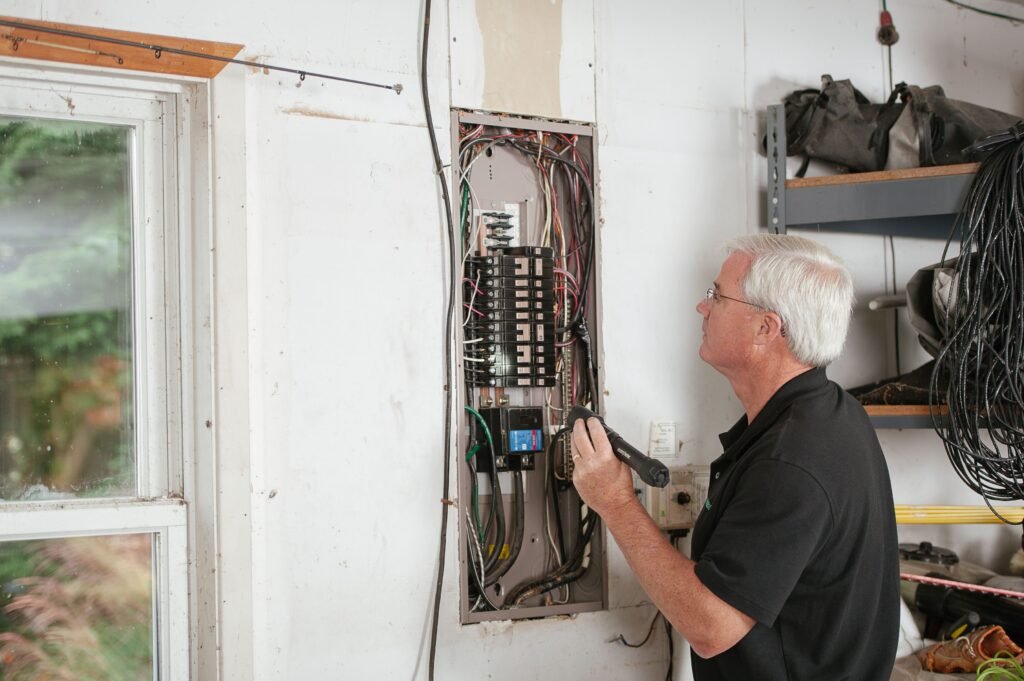
“The breaker tripped” is not specific enough on a dryer, and this is where most cold Maytags are actually fixed. Maytag describes the supply as “a separate 30-amp circuit fused on both sides of the line. This means there will be 2 circuit breakers to operate the dryer. One circuit will operate the motor (turning the dryer drum), while the other circuit will operate the heating element. If one of these is tripped, the dryer may not heat.”
Read that back against your symptom. A drum that turns while the clothes stay cold is the exact signature of one tripped leg, and half a 240 V breaker is genuinely difficult to see — the handle barely moves. Switch it fully off, then fully back on, rather than looking at it. That is a five-second check that costs nothing and ends a large share of these searches.
Maytag also names the power cord, which most pages skip entirely: “Ensure the power cord is properly installed… Also, ensure the terminal screws are tight at the dryer, and unplug the dryer before checking the terminal screws.” A dryer that has moved house, or been pulled out and pushed back, can run on one live leg forever and never heat. One strong opinion for this page: if your Maytag has been relocated and has never heated since, stop reading parts lists. That is an installation fault, and a 240 V cord is an electrician’s job, not an afternoon’s.
The Maytag gas valve check that needs no tools
On a gas Maytag the first check is free, and Maytag is unusually precise about how to read the valve rather than just telling you to check it: “The drum of a gas dryer will turn, but the dryer will not heat if the gas shutoff valve is closed. Open the gas shutoff valve in the supply line. The valve is open when the handle is parallel to the gas pipe.”
Parallel to the pipe, open. Across the pipe, shut. A valve knocked closed while somebody vacuumed behind the machine is unglamorous and extremely common, and it produces a perfect tumble with no heat at all. Past the valve sit the igniter, the flame sensor and the gas valve coils — and here is the honest limit: Maytag’s support pages never mention any of them. Its blog lists “Faulty flame sensors” only under what should be serviced. Maytag’s support flow deliberately stops at the cabinet on a gas machine, and saying so is more use than a parts list it never published.
Maytag ranks six causes, and the first two cost nothing
Maytag’s consumer article gives a six-cause list, and its ordering is more honest than the parts-retailer pages that rank by what they stock. Two of the six are not machine faults at all, which is the kind of thing a brand has no commercial reason to tell you.
- Clogged vent or lint screen. A clogged vent “leaves you either with a dryer that turns but does not heat (due to a high temperature limit being reached by the heating element) or a dryer that takes an extremely long time to dry.”
- Lack of power — the 240 V supply and both breakers on electric, the gas valve on gas.
- Too-large load sizes. “Make sure you are only filling up the dryer drum up to about ¾ full.”
- Soaking-wet clothes. Laundry that arrives too wet reads as a heat fault from outside the machine. Run a spin again before blaming the dryer.
- Heating elements — or the burner on a gas machine.
- Blown thermal fuse, which is more often a record of number one than a fault of its own.
On that last point: Maytag’s blog carries the sentence that settles it — “These fuses are a one-time device: when the temperatures within the dryer get too high, they will go off, shutting down the dryer. If your thermal fuse has activated, you must replace it before using the dryer.” A one-time device does not open at random. Something made the cabinet too hot, and fitting a new fuse into an unchanged vent is buying this repair twice. The part, the test and the reason are at dryer thermal fuse.
One Maytag vent instruction is worth quoting because it cuts against the usual advice: “Make sure your vent is installed properly with 45-degree elbows.” Most guidance simply says to avoid 90-degree bends. Maytag names the alternative.
A browned grille at the back of a Maytag drum is documented as normal
This one sends people looking for a fire they do not have, so it belongs on any Maytag heat page. The inlet grille inside the back of the drum goes brown or tan with age, and because the search that follows is “dryer scorching”, the answer that comes back is alarming and wrong.
Maytag has published a page about it, with before-and-after photographs. Its verdict: “This is normal and is caused by several factors, including usage, color transfer from clothing, and heat. This discoloration is permanent and will not wear off on any other clothing or material.” Permanent, harmless, and not the reason your dryer is cold. A browned grille and a burning smell are two entirely different conversations, and only the second one starts at the breaker.
Maytag will sell you a vent test kit, which tells you where it thinks the fault is
Across all four Maytag pages read for this article — the no-heat page, the code list, long dry times, and clothes wet at the end of a cycle — one block of text repeats on every single one. It is an offer to sell you part #W11224254, a dryer vent testing kit, described as helping you “easily assess the performance of your dryer vent system, ensuring optimal airflow and reducing the risk of fire hazards.”
Take that as diagnostic information rather than marketing. A manufacturer that prints the same vent-test offer on four unrelated dryer complaints has told you what its service data says the common denominator is. You do not need the kit to get the same answer. Maytag’s own free version, from the wet-clothes page: “Run the dryer for 5-10 minutes. Hold your hand under the outside exhaust hood to check the air movement. If the air movement is less than a hair dryer on high speed, clean the lint from the entire length of the system and the exhaust hood.” That is a physical measurement anyone can make in a minute, and it beats guessing. The full method is at how to clean a dryer vent.
Five findings on a Maytag that end the do-it-yourself route
Not a sign-off. Each of these is something you can look at and confirm, and any one of them means the dryer stays off.
- You smell gas near a gas Maytag. Operate no switch. Leave the building and call the gas supplier from outside.
- Scorching, melting or browning at the plug, cord, outlet or terminal block. That is supply side. Electrician, and the breaker stays off until they arrive.
- The dryer has never heated since it was installed or moved to this spot. The install is the suspect, not the machine.
- A replaced thermal fuse has opened again. The restriction was never cleared, or a thermostat is holding the heat on. Do not fit a third.
- The
AFcode or Check Vent light returns after you have cleaned the full duct run and the hood. Something further in is restricted, or the airflow sensing has failed.
Never bypass a thermal fuse or a safety thermostat, not even to test the rest of the machine. Those parts exist because dryers start fires.
FAQ
Why is my Maytag dryer running but not heating?
Because tumbling and heating are separate systems that meet only at the control. Maytag says so directly. The motor turns the drum; the element or burner supplies the heat. Interrupt the heat and the machine runs flawlessly and dries nothing.
How do I reset a Maytag dryer that will not heat?
The documented procedure for the low-voltage condition is the breakers off for one minute, back on, then a timed heated cycle. If the same code or the same cold load comes back, the reset worked perfectly and the fault is real. Resetting a second time changes nothing.
Where is the model number on a Maytag dryer?
Inside the door, on the rim of the opening, on a standard dryer. On a stacked laundry pair it is on the inside of the dryer door. Get it before ordering any part — fuse temperature ratings and terminal spacing vary by model.
Does a Maytag dryer have two circuit breakers?
An electric one does. Maytag describes a separate 30-amp circuit fused on both sides of the line, with one circuit running the motor and the other running the heating element. A gas Maytag runs its controls from a standard outlet and needs no 240 V supply.
Is a Maytag dryer not heating worth repairing?
Usually. Four of Maytag’s six causes cost nothing to address, and a fuse or an element is a modest part. The arithmetic changes once a quote passes half the price of a comparable new dryer, or the machine is past eight years old.
Why does my Maytag heat but leave the clothes damp?
That is airflow, not heat — the moist air is not leaving the house. Clean the lint screen, then the whole duct out to the exterior hood, then check the hood flap actually opens while the dryer runs. Maytag’s interval for the duct is every one to two years.
Read Maytag’s own pages before you buy a Maytag part
Four free checks and one physical measurement cover most of these machines: the cycle you selected, both breakers, the gas valve, the lint screen, and a hand held under the exterior hood. Nothing bought, no cabinet opened, no tools beyond a wrench for the cord terminals.
What stands out after reading Maytag’s four pages end to end is how short its own cause list is, and how consistently it points at the vent. The parts industry’s version of this search is much longer and much more expensive. Maytag’s is five things and a hand in the airflow.