Last Updated on October 4, 2026 by Umar Farooq
An automatic water shutoff valve is a motorised valve on your water supply that closes by itself when something tells it to — a floor sensor that got wet, or a flow pattern that says water has been running for an hour with nobody home. It is the only category of leak hardware that reduces how much water ends up on your floor, rather than how quickly you find out about it. Everything else in this market shortens the discovery time. This closes the tap.
The costly error in the title is not a brand. It is ordering by brand and discovering the bore is wrong. These valves come in 3/4-inch, 1-inch and 1-1/4-inch versions that look near-identical in a photograph, and a valve that does not match your main line is a return, a delay and sometimes a second plumber’s visit. Measure before you shop. That one step prevents most of the regret in this category.
> Disclosure: washerfixlab.com is a participant in the Amazon Associates Program. If you buy through a link on this page we may earn a commission, at no extra cost to you. We choose products on specification and fit, not on commission, and we say when something is not worth buying.
What closes the water, and what only tells you about it
Three different things get sold as leak protection and only one of them moves a valve.
A sensor detects water and makes a noise. A monitor measures flow and notices a pattern that should not be there. A valve closes. Plenty of listings blur the three, and the word “smart” attaches to all of them equally, so the only reliable test is to look for a motor and a valve body in the specification. If the product has no moving water-bearing part, it cannot stop water, regardless of how good the app is. The four classes and which one suits which household are laid out on our best water leak detector page.
Within the valve category there are then two architectures, and they suit genuinely different houses. A sensor-triggered valve closes when a puck on the floor gets wet — it is reacting to water that has already escaped, so it is fast and dumb, in the good sense. A flow-triggered valve closes when the water passing through it stops looking like household use: continuous flow for longer than any shower, a trickle that never ends, a pressure decay with every fixture shut. It catches the leak inside a wall that no floor sensor is near. Most of the better systems do both, and if you can only have one, take the flow-triggered one and add sensors to it, because hidden leaks are the ones that run for weeks.
Before you buy, go and turn the stopcock you already own
This is the free step, and it is genuinely the most useful thing on this page.
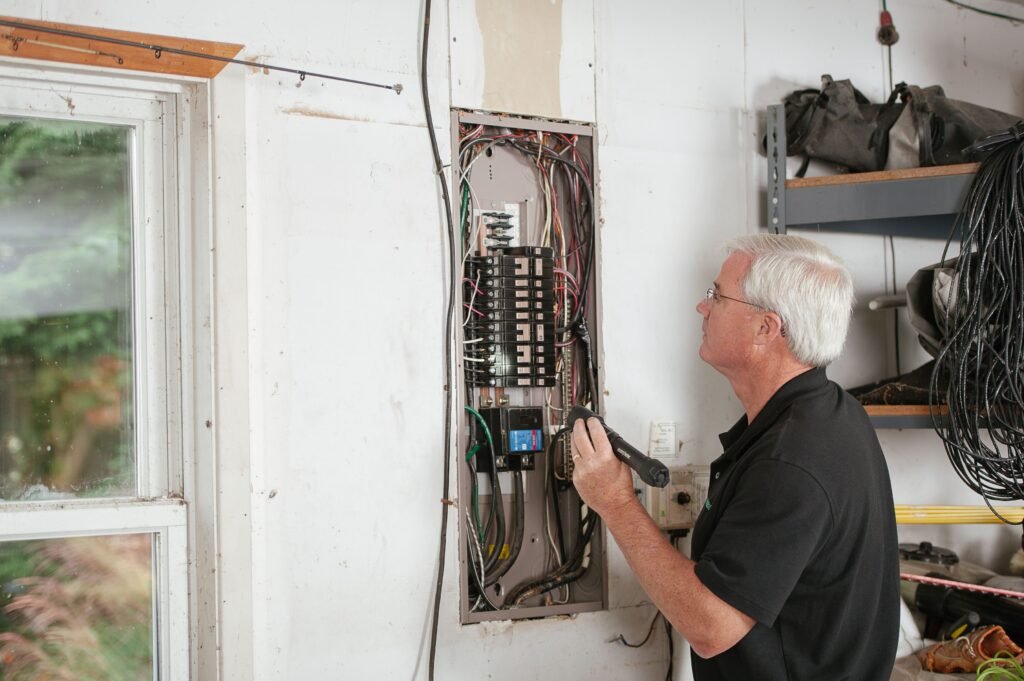
Find your main shutoff — usually where the supply enters the house, often near the meter, sometimes in a basement or a crawl space — and turn it off. All the way. Then turn it back on. Three things come out of that one minute, and all of them matter more than any product below.
You learn where it is, which is the thing nobody knows at two in the morning with water coming through a ceiling. You learn whether it still turns, because gate valves that have sat untouched for fifteen years regularly seize, and a seized main stop is a real emergency waiting to happen. And you learn what it looks like — a round handwheel usually means an old gate valve, a lever means a ball valve, and that distinction decides whether a bolt-on actuator is even an option for you.
If the stop will not turn, stop reading about smart valves and get that replaced first. An automatic valve downstream of a seized manual one is a system with no manual override, which is a worse position than you started in. And while you are down there, note the pipe’s outside diameter and the material — copper, CPVC, PEX or galvanised steel. You are going to need both numbers.
An automatic water shutoff valve has to fit your pipe, not your plan
Three specifications decide fit, and getting any of them wrong turns a purchase into a return.
Bore. Residential mains are commonly 3/4-inch or 1-inch, with 1-1/4-inch on larger or older homes. This is the nominal pipe size, not the outside diameter you measure with a tape, so the honest method is to read the stamping on an existing fitting or measure the outside diameter and convert. Copper at 3/4-inch nominal measures about 7/8-inch across the outside; 1-inch nominal measures about 1-1/8. Guessing between those two is the single most common way this goes wrong.
Flow capacity, not just thread size. A valve narrower than your main throttles the whole house, and you will notice it in the shower when someone flushes. Look for a full-port valve — one whose internal bore matches the pipe rather than stepping down inside the body. Manufacturers who are proud of this say “full port” in the specification. Ones who do not mention it are often not.
Pressure rating against your actual pressure. Domestic supply pressure that sits at the high end shortens the life of everything downstream, and a valve has a stated working range. Frizzlife, for example, rates the LPG365 for 0-110 psi and 34-122°F. If your house is already producing banging pipes on valve closure, you have a pressure or arrestor problem that a fast-closing motorised valve will make more obvious, not less — see water hammer washing machine for why a quick-closing valve and high pressure are a bad combination.
The fourth question is not a specification but it decides the whole purchase: is the pipe accessible, and is there a power outlet near it? Every one of these valves needs mains power. A beautifully specified valve on a main line in a sealed crawl space with no socket is a project, not a purchase.
Cut into the line, or bolt onto the valve you already have
This is the real fork in the road, and it is the one most buyers do not know exists until the plumber quotes them.
The inline valve replaces a section of pipe. The line is drained, cut, and the new valve body is soldered, pressed or compression-fitted in. It gives you the most capable device — a full-port valve with flow and pressure sensing in the same body — and it almost always means a plumber, a half day, and in some jurisdictions a permit for work on the main. The payoff is that the device sees every drop entering the house and can act on patterns rather than only on sensors.
The bolt-on actuator does not touch the water at all. It clamps to your existing ball valve and motorises the handle. YoLink’s EVO valve operator is the clearest example of the type: a 12 V direct-drive unit that replaces the valve’s handle and drives the valve shaft directly, fitted with a Phillips screwdriver in about fifteen minutes with no pipe cutting. For a renter, for anyone who does not want to open their main, or for a reader who simply cannot justify a plumber for this, it is a legitimate answer and it closes the same water.
What you give up with an actuator is measurement. It has no idea how much water is flowing, so it can only react to a sensor getting wet. It also depends entirely on your existing valve being a lever-handle ball valve in good condition — an actuator on a stiff or corroded valve either stalls or shears something, and neither is a good evening.
What happens when the power fails, and the question to ask before buying
Every one of these valves needs electricity to move. What varies, and what the listings are vague about, is what the valve does when it has none.
Almost all of them fail in place: a power cut leaves the valve exactly where it was, which for an open valve means your protection is off until power returns. That is the right engineering decision — a valve that defaulted closed would shut your water off every time the lights flickered — but it means a storm that takes out power and bursts a pipe is precisely the scenario the device sits out. Backup matters for that reason, and the better systems carry it: Frizzlife’s unit runs on a rechargeable lithium cell behind the mains adapter, and YoLink’s X3 line is built around long-life lithium with a stated 10-plus years between battery changes.
The second question is what happens to the internet rather than the power. A system that needs a cloud round-trip to decide to close is a system that does nothing during an outage. Local or device-to-device operation — where the sensor talks straight to the valve controller without passing through a server — is the feature worth paying for, and YoLink’s D2D pairing is an example of it done explicitly. Ask the question before you buy: if my router is off, does the sensor still close the valve? If the answer is no, you have bought a device that works except during storms.
Three valves, for three different plumbing situations
These are not ranked. They are three different answers to the question “what can actually be installed in my house”.
Moen Flo 1-1/4-inch: for a large main and a plumber already booked
This is the full inline unit for a bigger bore — Moen’s 900-002, the 1-1/4-inch member of the Flo range, where the 900-006 covers 1-inch. Per Moen, it monitors flow, pressure and temperature around the clock, runs a daily MicroLeak test that can find leaks as small as a drop per minute, and closes the valve automatically. Brass body, Wi-Fi, 12 V mains supply, and a documented temperature range of 32 to 140°F. Moen’s own Flo smart water monitor and shutoff listing carries the full specification sheet.
Who it suits: a house with a 1-1/4-inch main, an accessible run of pipe with a socket nearby, and an owner who is prepared to pay for the cut-in. It is also the one to choose if your insurer offers a credit, because insurers tend to recognise monitored whole-home shutoff rather than alarms.
What it does not do: it does not fit smaller pipe. Buying the 1-1/4 for a 1-inch main is not a minor mismatch you can adapt around without throttling the house. It also will not protect anything teed off upstream of it, which on many houses includes the outside taps and the irrigation line.
[[AMZ:B07W9LV16S|Check Price on Amazon]]
Frizzlife LPG365 with three leak sensors: both trigger types in one box
This one is interesting because it does not force the sensor-versus-flow choice. It is an inline valve with ultrasonic flow measurement down to 0.01 GPM — fine enough to see a drip rather than only a burst — and it ships with three wireless leak sensors that can trigger the valve directly, with a stated 15-second shutoff and LoRa radio for the sensors rather than Wi-Fi. Frizzlife lists it as fitting both 3/4-inch and 1-inch, with the adapters in the box, which removes one of the two ways this purchase usually goes wrong.
Who it suits: a 3/4 or 1-inch main where you want the hidden-leak coverage of flow monitoring and the instant reaction of floor sensors, without buying two systems. The dual fitment also makes it the safer choice if you are genuinely unsure of your bore, though you should still go and measure.
What it does not do: it is still a cut-in, so the plumber question has not gone away. And a flow monitor on the main cannot see drain-side water at all — a washing machine drain hose that works its way out of the standpipe moves water this valve has already counted. That one is caught by a sensor on the floor, which is why the bundled three matter.
[[AMZ:B0GJRQMPGM|Check Price on Amazon]]
YoLink X3 shutoff kit with EVO and four sensors: for the house you cannot cut into
This is the kit for the reader whose answer to “can a plumber cut your main?” is no — a rental, a finished wall, a budget that does not stretch to a trade visit. The X3 controller pairs with YoLink’s EVO valve hardware and four leak sensors on 923.3 MHz LoRa, which the manufacturer rates at up to a quarter-mile open-air range, and that radio choice is the reason sensors in a basement or crawl space still reach the controller when Wi-Fi does not. Device-to-device pairing means a wet sensor can close the valve with the internet down.
Who it suits: long distances between sensor and valve, awkward buildings, and anyone who wants the sensors and the actuator from one ecosystem rather than bridging two apps.
What it does not do: there is a fitment check here that the listing makes easy to miss. YoLink sells both motorised valves that plumb in and the EVO bolt-on operator that drives an existing ball valve — confirm which variant you are ordering, and if it is the bolt-on, confirm your existing stop is a lever-handle ball valve that turns freely. YoLink’s EVO valve operator collection sets out the attachment method. It also has no flow sensing, so it reacts to sensors only, and it needs a hub with an internet connection for app control.
[[AMZ:B0DTP7J9Z7|Check Price on Amazon]]
Who should not fit one of these
If the leak you are worried about is one specific appliance, a whole-home valve is overkill and a worse fit than the appliance-level alternative. A washing machine hookup kit puts two valves on the two hoses that actually fail, costs a fraction of a main-line install, and needs no plumber because it threads onto the taps you already have.
If your house is occupied nearly all the time and you have no second property, sensors alone capture most of the benefit for a small fraction of the money. The valve earns its keep in the hours nobody is home. If that number is close to zero, be honest about it.
If your main stop is seized, fix that first, as above. And if you rent, check your lease before cutting anything — the bolt-on actuator exists precisely because this is a common position, and it is reversible.
FAQ
Can I install an automatic water shutoff valve myself?
The bolt-on actuator type, usually yes — it attaches to an existing ball valve with hand tools and does not open the water system. The inline type is plumbing work on the main: the line has to be drained, cut and rejoined, and some jurisdictions require a permit or a licensed plumber for work on the service line. Check locally before you buy, because the labour is often a larger cost than the device.
Will it shut off the water to the whole house or just one appliance?
That depends entirely on where it sits. On the main, it closes everything downstream of it — which excludes any branch teed off before it, commonly the outside taps and irrigation. At an appliance hookup, it closes only that appliance’s hot and cold supply and leaves the rest of the house running normally.
What happens if the power goes out?
Almost all of these valves stay exactly where they were, which means an open valve stays open and the automatic protection is suspended until power returns. Models with battery backup keep working through it; models without do not. This is worth confirming in the specification before buying rather than after.
Does an automatic shutoff valve reduce water pressure?
A full-port valve should not noticeably, because its internal bore matches the pipe. A valve that steps down internally, or one sized below your main, will throttle flow and you will feel it when two fixtures run at once. This is why bore and full-port construction matter more than any app feature.
Can a shutoff valve stop a washing machine drain leak?
No, and this is the most useful limitation to understand. A supply-side valve controls water going into the house or the appliance. A leak from a drain hose, a pump housing or a filter flap is water that has already been supplied and measured. Only a floor sensor catches that, which is why the better kits bundle sensors with the valve.
How long does the valve take to close?
Published figures sit in the seconds rather than minutes range — Frizzlife states 15 seconds from sensor trigger on the LPG365. At a supply hose failure rate of roughly 650 gallons an hour, a few seconds is a small puddle rather than a flood, which is the whole point of the category.
Measure the pipe first, and everything else follows
The order that avoids an expensive mistake is: go and turn your main stop, note whether it turns and what kind of valve it is, measure the pipe, check for a power outlet within reach, and only then open a product listing. Four of those five steps are free and the fifth is a tape measure.
If the main is accessible and you are willing to pay for the cut-in, an inline valve with flow monitoring is the more capable device and the one that catches leaks inside walls. If it is not, or you rent, the bolt-on actuator closes the same water for a fraction of the disruption and no plumber. And if what you actually lie awake about is the washing machine rather than the house, buy at the hookup instead — it is the cheaper, better-targeted answer, and it is covered on our washing machine leak detector page.
[[AMZ:B0GJRQMPGM|Check Price on Amazon]]