Last Updated on October 4, 2026 by Umar Farooq
A portable dryer for apartments is a venting decision before it is a shopping decision. These machines are vented, not condensing — they push the water out of a four-inch hose as warm wet air — so the real question is where that hose is allowed to go in a home you do not own. Get that wrong and the water from every load lands on your walls, and under most leases the resulting damage is yours.
> Disclosure: washerfixlab.com is a participant in the Amazon Associates Program. If you buy through a link on this page we may earn a commission, at no extra cost to you. We choose products on specification and fit, not on commission, and we say when something is not worth buying.
Start with the lease, not the listing
Three clauses decide this, and they are usually in different parts of the document. The alterations clause governs whether you may make a hole in anything — a wall, a window frame, a door panel. In most standard residential leases you may not, and “it is only four inches” is not a recognised exception. The appliances clause sometimes names laundry equipment directly, particularly in buildings where the landlord operates a coin laundry and does not want the competition. And the condition and damage clause is the one that bites later, because it makes you liable for moisture damage you caused, whether or not anyone told you not to cause it.
Nothing here requires a confrontation. A short written question to the managing agent — “may I run a vented portable dryer with the exhaust through the window, using a removable insert?” — produces an answer you can keep. A yes in an email is worth more than a yes in a doorway, and a no saves you the purchase.
What a landlord almost always will permit is a machine that puts nothing through the building fabric. That is why the distinction between vented and ventless is worth understanding before you shop rather than after, and why some renters end up choosing a condensing machine instead. Compact dryer covers what the ventless classes require in exchange.
Where a portable dryer for apartments puts the water
A load of laundry coming out of a washer holds several pounds of water. That mass does not disappear in a dryer, it changes address. On a vented machine it is carried out of the drum in hot air and pushed through the exhaust port. If the hose goes outside, the water leaves the building. If it does not, every ounce arrives in your flat.
Pay attention to where it lands, because it does not spread evenly. Warm wet air rises, meets the coldest surface in the room, and condenses there — the window reveal, the external corner behind a wardrobe, the cold spot on an uninsulated wall. That is the mechanism behind the black speckling along a window frame in a rented flat, and it is why a tenant who dries laundry indoors through a winter can find themselves arguing about a deposit in the spring.
The EPA’s guidance is unambiguous on both halves of this: “Vent appliances that produce moisture, such as clothes dryers, stoves, and kerosene heaters to the outside where possible,” and keep indoor humidity below 60 percent, ideally between 30 and 50. The same agency notes in its mold and health guidance that “It is important to dry water damaged areas and items within 24-48 hours to prevent mold growth” — the corollary being that a surface which stays wet for longer is a surface that grows something.
Three ways to get moist air out of a rented room
In descending order of how well they work and ascending order of how much explaining they need.
Through a window, with a removable insert. The standard approach: a panel cut to the width of a sash or sliding window, with a four-inch collar in it, held in place by the window closing on it. It is reversible, it leaves no marks, and it is the one arrangement most agents will agree to in writing. The weak point is winter, because an open window with a panel in it is also a draught, and it is the honest reason a lot of people stop using the dryer in January.
Through an existing opening. If the flat already has a trickle vent, a disused extract, or a through-wall air conditioner sleeve, that hole has already been approved by somebody. Using it is not an alteration. This is the best outcome available to a renter and it is worth half an hour with a torch to find out whether you have one.
Not at all, with a dehumidifier running. The least good option, and still better than nothing. The dryer dumps its moisture into the room and a dehumidifier takes it back out and puts it down a drain. It costs you two appliances running at once and it never quite keeps up during the cycle, but it stops the water accumulating in the fabric of the building. If this is the plan, size it properly: the specification that matters is continuous drainage and auto-defrost, not the pint rating on the box.
What does not work, despite being sold: the indoor vent kit with a tub of water in it. The lint settles in the water; the humidity goes into the room anyway. It is a lint filter, not a venting solution, and calling it the latter has caused a lot of damp walls.
The circuit behind the outlet, and what else is on it
Apartment wiring is where this quietly goes wrong. A 120-volt, 15-amp branch circuit supplies 1,800 watts at maximum, and in a small flat that circuit frequently serves the whole living area — the outlet behind the sofa, the one by the counter, and the one you were planning to plug a dryer into. A 1,500W dryer leaves 300 watts of headroom. A kettle takes all of it and more.
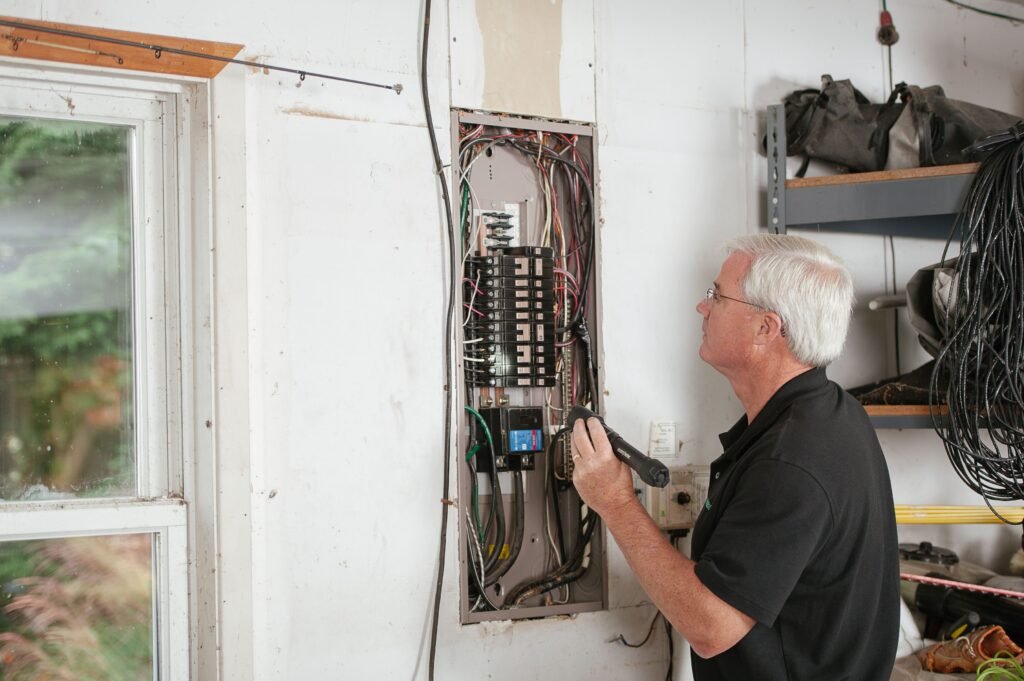
The symptom is not usually a dramatic failure. It is a breaker that trips forty minutes into a cycle, once, and then not again for a fortnight, so nobody connects it to the microwave. The fix costs nothing: find out which outlets share the breaker by switching it off and walking round with a lamp, then run the dryer when nothing else heavy is on that circuit. Does a washing machine need a dedicated circuit explains how the manufacturers’ own supply requirements are written, and the same logic applies here.
Never run one of these from a light-duty extension lead. A 1,500W continuous load on a thin cord is the one genuinely dangerous thing on this page.
Noise through a shared wall, and the hours you can run it
A tumble dryer makes two noises: a low rumble from the drum and a higher drone from the blower. In a house those disappear. In a flat with a party wall and a floating floor, the rumble couples straight into the structure, and a machine on a wall bracket couples into it even better, which is the part the wall-mounting feature never mentions.
Three things help and none of them are products. Stand the machine on the floor rather than a shelf or a bracket if the wall is shared. Put it on something that absorbs — a dense mat, not a towel. And start the cycle early, because a 1,500W plug-in dryer takes between ninety minutes and three hours, so a load begun at 9pm is a load still running at midnight. That is how these machines generate complaints, not by being especially loud.
Three dryers for a rental, ranked by what you may install
Three machines matched to three permissions. All three are vented; the exhaust still has to go somewhere.
Winado 1.5 cu. ft., 850W, with exhaust hose. The one for the smallest permission and the smallest room. 19.5 by 16.1 by 23.8 inches, it ships with an exhaust hose and a mounting bracket, and Winado is refreshingly specific about capacity: approximately 5.5 pounds of wet clothes, at a rated 850 watts. That is a small load — a few shirts and underwear, not towels. At 850W it is also the least likely of the three to trouble a shared circuit. The manufacturer’s own instruction is worth repeating before anyone shuts it in a cupboard: “avoid placing it inside a closed cabinet.”
[[AMZ:B0H8N59SLQ|Check Price on Amazon]]
Feelfunn 3.5 cu. ft., 1,500W front load. The largest drum here, with LED touch controls, four modes, a stainless drum, a maximum of 140°F and a wall-mount option. It measures 24 inches wide by 22 deep by 26.8 high and weighs 55.1 lb. The reason to choose it over the BLACK+DECKER below is the lower height, which lets it sit under a 28-inch counter overhang where the taller machines will not. The reason to think twice is the wall mounting — it is the feature that sells this class to renters and the one most likely to breach an alterations clause and transmit noise next door.
[[AMZ:B0F8H994SL|Check Price on Amazon]]
BLACK+DECKER 3.5 cu. ft., 1,500W, BCED37. The current best seller in the Clothes Dryers category, and the one with the most complete venting hardware in the box: a 4-inch diameter vent hose and exhaust connector, plus lint and exhaust filters. 13.2 lb of load, four modes, 23.6 by 21.5 by 27.5 inches, 49.5 lb. BLACK+DECKER publishes the cycle range rather than hiding it — 30 to 200 minutes. Suits a renter who has somewhere real to vent and wants a machine with the parts already matched. It is too heavy to be moving in and out of a cupboard each week.
[[AMZ:B082YGFMQZ|Check Price on Amazon]]
When the building laundry is the better answer
If your building has machines, use them. This is not a counsel of defeat, it is arithmetic: the building’s dryers are 240-volt, properly ducted, and finish a load in forty-five minutes rather than three hours, and the water from your laundry ends up outside somebody else’s wall. The case for a machine in the flat rests on inconvenience and privacy, which are real, but they are not worth a damp problem.
Do not buy one if you cannot vent and cannot run a dehumidifier — that combination guarantees the moisture stays. Do not buy one if your lease forbids alterations and you have no existing opening, because the only remaining route is the one that damages the flat. Do not buy one if your laundry is already arriving at the rack dripping, because that is a spin problem and a dryer is an expensive way to avoid fixing it. And do not buy the biggest drum you can find — portable clothes dryer explains why a packed drum on a household plug is how the three-hour cycle happens. And do not buy one for towels and bedding on an 850W machine — the energy is not there, and you will be running it overnight above somebody’s bedroom.
FAQ
Can I put a portable dryer in an apartment without a vent?
Physically yes, sensibly no. These are vented machines, so unvented operation releases the full water content of the load into the room. If you genuinely cannot vent, pair it with a dehumidifier sized for the space, or choose a condensing machine instead, which collects the water in a tank.
Will my landlord allow a portable dryer?
Usually, provided it makes no permanent hole. Ask in writing and describe the venting arrangement specifically — a removable window insert is the version most agents accept. Check the alterations and appliances clauses before you ask, so you already know what you are proposing.
Does a portable dryer need a special outlet?
No, it uses a standard 120-volt three-prong socket. What it needs is a circuit with capacity to spare. A 1,500W machine on a 15-amp circuit shared with a kettle or a heater will trip the breaker, so identify what else is on that breaker before you commit to a position.
How much moisture does one load actually put in the room?
Enough to matter. A medium load carries several pounds of water, which is why an unvented dryer in a closed studio pushes the relative humidity well past the 60 percent line the EPA warns about, and why the condensation appears on the coldest surface rather than evenly.
Get it in writing, then get the air outside
The order that works: read the alterations clause, find out whether the flat already has an opening you can borrow, ask the agent in an email, and only then look at drums and wattage. Every expensive version of this story starts with the machine arriving first and the venting question being solved afterwards with whatever is to hand.
A dryer that is allowed, vented and run on a circuit with headroom is a genuinely good purchase for a renter. The same machine with the hose coiled on the floor is a humidifier you paid for, and the damp is on your deposit. If you have somewhere to put the hose, the BLACK+DECKER arrives with the hose and connector already matched to it.
[[AMZ:B082YGFMQZ|Check Price on Amazon]]