Last Updated on September 22, 2026 by Umar Farooq
A washing machine overflowing right now is stopped at the wall, not at the control panel. Turn both supply taps clockwise until they are fully closed. Do that before you press cancel, before you open the door, and before you reach for the plug. Everything else on this page can wait ninety seconds. The taps cannot.
That order is mechanical rather than cautious. An inlet valve that has failed open is held open by water pressure, not by the control board, so cancelling the cycle or killing power changes nothing. The machine keeps filling, quietly, while you stand there having done the thing every other guide told you to do first.
The first sixty seconds
Work through these in order. Do not skip ahead to diagnosis while water is still arriving.
- Close both supply taps behind or above the machine — hot and cold, both fully off. If they are seized, close the main water shutoff for the property instead.
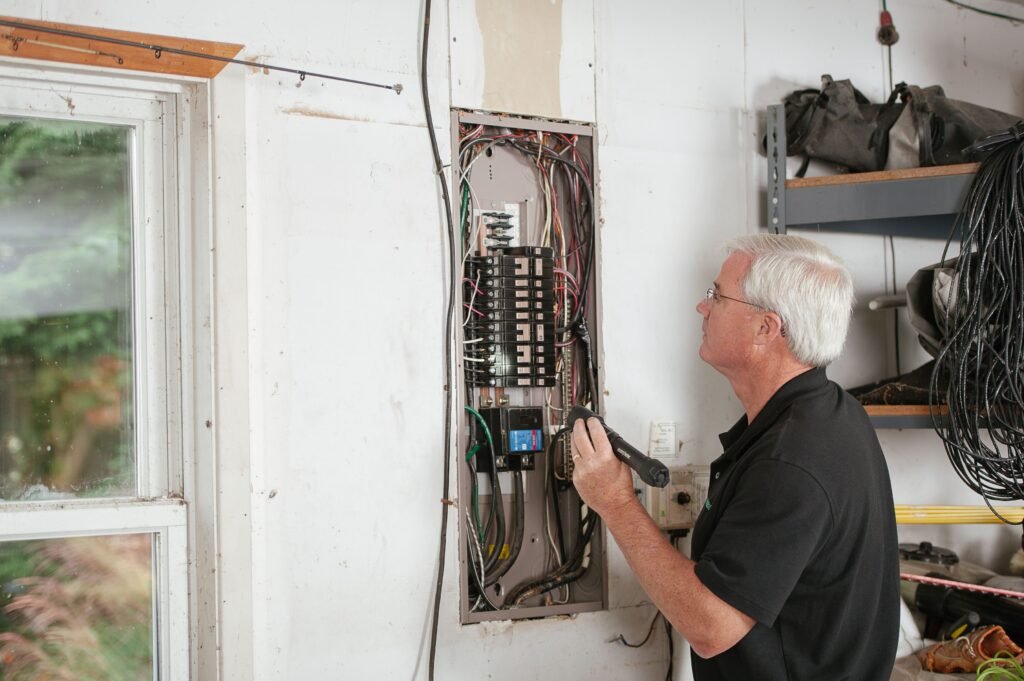
- Cut power at the breaker, not at the plug, if the outlet, cord or your own feet are anywhere near water. The laundry breaker is usually labelled; if it is not, switch the main.
- Do not stand in water to reach a socket. If the outlet itself is wet, leave it alone entirely and call an electrician.
- Do not press Cancel or Drain as your first move. On many machines that starts the pump, which pushes water into a standpipe that may be exactly what is already backing up.
- Contain the water with towels along the front edge and at the lowest corner of the room.
- Leave the door shut on a front-loader until the drum level is below the glass. Opening it releases the whole tub onto the floor in one go.
Stop-use warning. Do not run the machine again until you know why it overflowed. If water reached the cord, plug, outlet or any electrical component, keep the breaker off and have it checked. If the machine also tripped a breaker or a GFCI, treat that as an electrical fault first — see washing machine trips breaker — and do not simply re-arm it.
Why the taps come first, in numbers
A washing machine supply hose sits at roughly 70 pounds of pressure, permanently, whether the machine is running or not. When one fails it puts out around 650 gallons an hour — a weekend away is about 31,000 gallons arriving through your laundry floor. State Farm alone paid nearly $30 million on those claims in 2020, and supply hose failures account for more than half of all washing-machine-related losses (State Farm newsroom).
That is not there to alarm you. It explains the sequence. The supply side is the only part of this that can keep delivering water indefinitely, and the only part that stops dead the moment you turn a tap. A drum holds perhaps fifteen gallons. The wall behind it holds however much you let through.
A washing machine overflowing splits into two different problems
Before any cause list is useful, decide which of these you have. They share a symptom — water where it should not be — and almost nothing else.
| What you see | What it is | Where it goes |
|---|---|---|
| Water level inside the drum climbing past normal, still rising | Overfilling — an inlet or level-sensing fault | This page, next section |
| Normal fill, but water on the floor | A leak, not an overflow | Leaking from the bottom |
| Water backing up out of the standpipe or a nearby drain | A drain restriction, often not the washer at all | Drain pipe overflowing |
| Foam, not water, coming out of the drawer or door | Excess suds | Sud or 5d error |
| Fills normally, then empties itself immediately | Siphoning | Fills then drains |
The row people get wrong most often is the second. A puddle on the floor with a normal water level inside the drum is not an overflow — nothing overflowed. Something leaked, and leaks keep a schedule that names the failed part. Chasing an inlet valve for that will cost you a part and fix nothing.
Overfilling during a cycle: the causes that matter
Ranked by how often each actually turns out to be the answer, not by how dramatic it sounds.
- A mechanically stuck water inlet valve. The solenoid has jammed open, so water flows whenever the taps are on. Nothing but the taps stops it.
- A drainage restriction the machine is fighting. Several brands run the drain pump automatically during an overfill to hold the level down. LG documents it plainly: “During normal operation, the drain pump is activated to prevent leaks” (LG front load washer error code list). If the pump filter is packed with lint, a modest inlet excess becomes a level that only climbs — and the valve was never the problem.
- A pressure switch or level sensor reading wrong. The switch reads air pressure through a narrow tube from the bottom of the tub. A cracked, pinched or blocked tube tells the control the drum is empty no matter how full it is, and the control does exactly what it is told.
- Siphoning from a drain hose pushed too deep. If the hose end sits below the water in the standpipe it seals and siphons, the machine detects a falling level, and it refills continuously to compensate. LG documents a limit of no more than 4 inches into the drainpipe (LG IE error code); Samsung specifies 6 to 8 inches. Check your own manual rather than a universal number.
- Excess suds sitting over the sensor port, which makes a full tub read empty. More detergent is the cause; more rinsing is the fix.
- A control board that never cuts the valve. Genuinely last, and diagnosed only after the four above are ruled out.
If yours is the second one, the overflow is a drainage fault wearing a fill costume — start at washing machine won’t drain instead.
The frightening one: it fills while switched off
This is the case that sends people looking for something supernatural, and it is the simplest fault on the list. A machine that fills while powered down, or unplugged at the wall, has a mechanically stuck inlet valve. Nothing is commanding it. The solenoid that should snap the valve shut has seized — grit, scale, a failed spring — and mains water pressure alone is pushing straight through it into the drum.
What that means practically: no button, no reset, no cycle and no breaker will stop it. The control board is not involved. The supply taps are the only thing between that valve and your floor, and they stay closed until the valve is replaced. If the taps will not seal, close the main.
One test separates this from every other cause, and it is worth doing before anyone quotes you for a part. Reopen the taps briefly with the drum empty, let the fill start, then cut power at the breaker while water is actively entering:
- Water stops the instant power dies → the valve is fine and is only being commanded open. Look at the pressure switch, the level tube, or suds.
- Water keeps flowing with no power → the valve is stuck open mechanically. It needs replacing, and the taps stay shut until it is.
Water on the floor with a normal fill
If the level inside the drum looks right and the floor is wet, you have a leak, and the useful evidence is when the water appears rather than where the puddle sits. Water runs downhill and emerges at whichever corner is lowest, so the puddle tells you about your floor, not your machine. Dry everything, lay paper towel front and back, run a cycle, and note the stage at which wetness first shows. That one observation narrows it to a component — the full timing test is in washing machine leaking from the bottom.
After the water stops
The machine still holds a full tub. Drain it deliberately rather than opening the door and hoping — the procedure is in how to drain a washing machine manually. Then check the pump filter, the drain hose depth, and the supply hoses for bulges or rust at the crimps.
When you do test it, stay with the machine for the whole cycle: fill stopping at the normal level, drum draining fully, no extra water arriving later. A machine that keeps adding water past the expected point has its own diagnosis path — see washing machine keeps filling.
The taps stay closed until a technician says otherwise
Each of these is something you can look at and confirm:
- Water continues entering with both supply taps confirmed fully closed.
- The taps will not close, or weep when closed.
- Water reached the outlet, the cord, or wiring inside the cabinet.
- The machine tripped a breaker or GFCI as well as overflowing.
- Water went under flooring, through a ceiling, or into a room below — that is a water damage assessment, not an appliance repair.
- An overflow code returns at the same point in the cycle twice after the checks above.
The taps are the repair until a technician says otherwise. Leave them closed.
FAQ
Should I unplug the machine or turn off the water first? Water first. A stuck inlet valve keeps filling with the machine unplugged, so cutting power alone leaves you watching a dead machine that is still flooding.
Why not just press Cancel? Because on many machines Cancel starts the drain pump, and if the standpipe is what is backing up, that adds to the flood rather than ending it.
My machine fills when it is switched off. Is that dangerous? It is a stuck inlet valve, and it will not stop by itself. Keep both supply taps closed until the valve is replaced. If the taps do not hold, close the main.
There is water on the floor but the drum looks normal. That is a leak rather than an overflow, and they have different causes. Time when the water appears during a cycle and start with leaking from the bottom.
Can too much detergent cause a washing machine overflowing at the drawer? Yes. Foam over the level sensor port makes a full tub read empty, so the control keeps filling. Run two or three empty cycles with no detergent to clear the residue.
It overflowed once and has been fine since. A one-off is a much narrower situation than a repeatable overflow. Check the pump filter and the drain hose depth, then watch it — but do not start replacing parts.
Is it safe to use the machine while I wait for a repair? No. Close the taps and leave it. An overflow that happened once with someone standing there happens again at 2am with nobody in the room.