Last Updated on October 26, 2026 by Umar Farooq
An apartment size washer is not a product category with a specification. It is whatever will physically get into your flat and connect to what is already there. The gap you are filling is rarely the binding constraint — the doorway, the stair turn and the absence of a standpipe are. Take five measurements, run one hookup audit, and the shortlist writes itself.
Do this before you open a single product page, because the answer decides whether you are shopping for a plumbed machine or a portable, and those are different purchases.
Disclosure: washerfixlab.com is a participant in the Amazon Associates Program. If you buy through a link on this page we may earn a commission, at no extra cost to you. We choose products on specification and fit, not on commission, and we say when something is not worth buying.
An apartment size washer is defined by your doorway, not the drum
A 24-inch compact weighs around 160 lb and a full-size one over 200. Neither turns a tight landing without two people and a sack truck, and deliveries get refused at the front door far more often than machines get returned for being the wrong capacity.
So the question is not “what size washer fits an apartment” but “what will get from the street to the gap”. That path has a narrowest point, and it is almost never the alcove: it is a door frame with the architrave on, a half-landing where the stairs turn back on themselves, or a lift car with a short diagonal.
Work the path backwards from the gap to the street and find the tightest dimension on it. That single number caps everything else. If an existing machine has to come out the same way first, how to move a washing machine covers the thing people forget — refitting the transit bolts.
Five measurements, taken before you order anything
Write these down to the nearest quarter-inch. All five, not the three that seem relevant.
- The gap: width, height and depth. Depth is measured to the back wall, then reduced by three to four inches for the hoses, which do not fold flat. A machine that fits the alcove on paper and sticks out two inches in reality is the commonest version of this mistake.
- The door swing. A front-loader needs a clear arc of roughly the door’s own width in front of it. Measure from the hinge side to the nearest obstruction — a worktop overhang, an opposite wall in a narrow utility cupboard, a unit at ninety degrees.
- The narrowest point on the route in. Door frames with the architrave in place, the stair turn, the lift. Measure the frame, not the doorway.
- Floor to the top of the standpipe. This is the number that decides whether the machine can actually drain, and it is covered in the audit below.
- The distance from the gap to the socket, the taps and the drain. Supply hoses are commonly four to five feet and drain hoses around five, and you cannot extend a compact or portable drain hose — GE states plainly that there are no extensions for compact or portable washers, because there is nothing to clamp one onto.
The hookup audit your building has already decided
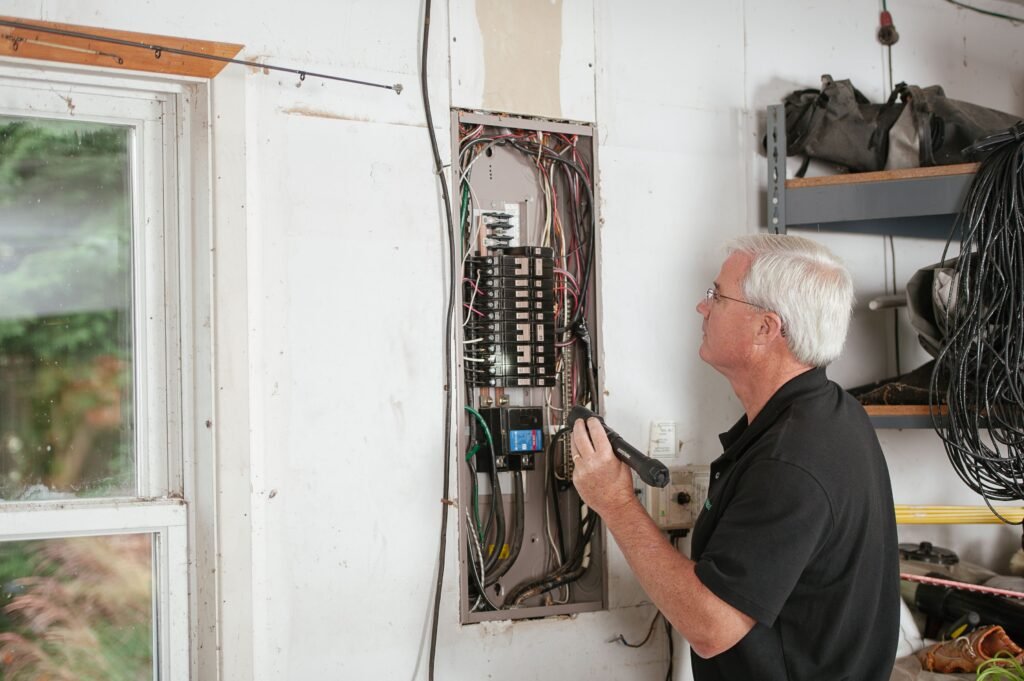
Open the cupboard, pull the panel, look behind the kitchen units. You are checking four things, and the answers put you on one of two branches.
Two taps, hot and cold, with hose threads. A compact washer needs both. A single cold tap is workable on some machines and not on others, so check the inlet count on the specification rather than assuming.
A standpipe, and its height. This is the vertical pipe the drain hose hooks into. Whirlpool gives the window for its own machines: the standpipe height requirements are 96 inches maximum and 30 inches minimum. Too low and the machine siphons itself empty mid-cycle; too high and the pump cannot clear it. If you are unsure what you are looking at, washing machine standpipe has the pictures.
A socket on the right circuit. A compact washer is a 120 V appliance, so a standard outlet is enough — but it wants to be an outlet, not an extension lead, and ideally not shared with the microwave.
What the building permits. Some blocks prohibit in-unit laundry, some require an insurance endorsement, some require a drip tray above ground level. Ask the managing agent and get the answer in writing.
All four pass and you are buying a compact. Any one fails and you are buying a portable that fills from a tap and drains into a sink — the format comparison is in compact washer.
Two machines for the two answers that audit gives
The audit passed: Contoure WH-2700T
A plumbed 24-inch compact, and the spin speed is the reason it is the one to look at. 2.7 cu. ft. in a stackable 24-inch front-load cabinet with 16 wash cycles, five temperature settings, five-stage LED touch controls, a stainless steel drum, automatic water level control and a 1,400 rpm maximum spin — the fast end of the compact class, and Contoure’s own listing gives the reason it matters: “1400 RPM spin speed ensures faster drying times.” In a flat with no dryer duct, every rotation of that spin is time you do not spend on an airer. It is rank 6 in RV Washers & Dryers, a category label that tells you something useful about the engineering rather than about RVs: machines sold into that market are built around tight cabinets and short hose runs, which is the apartment problem exactly. Being stackable, it also leaves the option of putting a compact dryer on top later rather than sideways. Check the 24-inch cabinet against the narrowest point on your route, not against the alcove — this is a plumbed appliance that needs two people and a clear path, and it is the measurement at the top of this page that decides whether it arrives at all.
The audit failed: ROVSUN 17.8 lb portable
A fully automatic portable that solves the exact two things the audit found missing: the tap and the standpipe. 1.5 cu. ft. and a 17.8 lb load in a top-loading cabinet, eight wash modes, five water levels, a stainless steel drum and a quick-connect sink adapter in the box, so it fills from an ordinary kitchen or bathroom faucet with no hose-threaded laundry tap anywhere in the flat. The part that matters more is the drain: it has a drain pump rather than a gravity hose, and ROVSUN states it “allows you to easily drain out water” to “a higher location,” which is what you need when there is no standpipe and the only drain in the room is a sink above the machine’s own waistline. It runs washing and spin drying in one sequence, with a 26-minute quick wash quoted for light loads. It is rank 3 in Portable Clothes Washing Machines. It will not heat its own water and it will not extract like a 1,400 rpm front-loader. The temperature of your wash is whatever comes out of the tap you connected it to, and clothes come out of the spin damper than they would from a plumbed compact, so plan on an airer or a rack for the drying half.
FAQ
What are the dimensions of an apartment size washer?
There is no standard, because the term is a retail label rather than a specification. In practice it covers compact machines around 24 inches wide, 23 to 26 inches deep and 33 to 36 inches tall, and portables from about 17 to 24 inches wide. Standard full-size machines are about 27 inches wide. Always use the specific model’s figures rather than the class.
Will a washing machine fit through a 24-inch door?
A 23-inch-wide compact will, with the door off its hinges and nothing to spare. A 27-inch full-size machine will not. Measure the frame with the architrave in place rather than the nominal door size, and remember the machine has to turn as well as pass through — the diagonal at a stair half-landing is usually tighter than the door.
How much clearance does a washer need at the back?
Allow three to four inches for the hoses. Pushing a machine flat against the wall kinks the inlet hose and crushes the drain hose, and on a front-loader it can also pinch the pressure-sensing tube, which makes the machine misread its own water level.
Can I put an apartment size washer in a closet?
Yes, if the closet has the hookups and is ventilated or can be left open while the machine runs. A front-loader sealed in a cupboard between washes is the fastest route to a mouldy door seal.
Measure the route in, not just the gap
The alcove is the measurement everybody takes and the one that least often causes the problem. Take the other four — stair turn, door frame with architrave, standpipe height, hose run — and the decision makes itself. Hookups present and a route wide enough for 160 lb of machine, and a plumbed compact is the better appliance by a clear margin — the Contoure is where that shortlist starts, because the 1,400 rpm spin is the specification that does the most for you in a flat with nowhere to put a dryer. Anything missing, and a portable that fills from the tap and pumps into the sink is not a consolation prize; it is the right answer to the building you actually live in.