Last Updated on October 4, 2026 by Umar Farooq
A laundry folding table is a flat surface at standing height next to the machines, and the reason to have one is not tidiness — it is that clothes only fold well in the few minutes they are still warm, and if there is nowhere to put them down they go into a basket instead and come out creased. The phrase does double duty, confusingly: some of these tables fold laundry, some of them fold themselves, and most of the good ones do both.
Before any of that, the number that decides whether you use it or not is its height, and almost nobody checks it.
Disclosure: washerfixlab.com is a participant in the Amazon Associates Program. If you buy through a link on this page we may earn a commission, at no extra cost to you. We choose products on specification and fit, not on commission, and we say when something is not worth buying.
Warm from the dryer is the only time creases fall out by themselves
Whirlpool’s own support guidance states the mechanism without any drama: “when you cannot remove a load of clothes from the dryer as soon as it stops, wrinkles can form,” and the instruction that follows is “promptly remove garments once the cycle ends” (Whirlpool — how Wrinkle Prevent option works). Manufacturers build a whole feature around this — the tumble that continues after the heat stops, sold as Wrinkle Shield, Wrinkle Prevent or Wrinkle Guard — precisely because a cooling heap sets whatever shape it cooled in.
That is the honest case for a folding surface and it is a narrow one. The window is short, the fabric is still relaxed, and what you need in that window is somewhere to put a shirt down flat within arm’s reach of the door. A basket is not that. A bed in another room is not that either, because the walk is what turns “I will do it now” into “I will do it later,” and later is when it is cold and creased.
If there is no space for a table at all, the free version is the top of the machines — but only on a front-loading pair, and only with something over the lid so buttons and zips do not scratch the paint. On a top-loader the lid is the folding surface and it is also the thing that has to open, which is why top-loader households are the ones that actually need a table.
Work the height out from your own elbow, not from the catalogue
Folding is a standing task done with both hands, and the comfortable surface for that sits a little below your elbow — roughly three to five inches below, which for most adults lands somewhere between 34 and 39 inches. The spread in this category is far wider than that.
A commercial stainless prep table is built for kitchen work and lands around 34 to 35 inches, which is right. A wall-mounted folding desk is usually built as a desk, and a desk is 29 to 30 inches, which is a seated height. Fold standing at a desk-height surface for ten minutes and your lower back will tell you about it. One stainless table in this category publishes an overall height of 31.5 inches, which is honest of it and still low for standing work.
Measure yourself rather than trusting a number. Stand with your arms at your sides, bend your forearms level, and have someone measure from the floor to the underside of your elbow; take four inches off that. That figure is the table top height you want, and for a wall-mounted unit you control it completely, because you decide where the brackets go. It is the single biggest advantage a drop-down table has over a freestanding one and hardly anybody uses it.
Depth decides whether a bath towel actually fits
The second number, and the one that quietly makes a table useless. Take the towel you fold most often, fold it the way you actually fold it, and measure the result. Then do the same with a fitted sheet. Those two measurements are your minimum depth, and in most households the answer comes out around 18 to 20 inches for towels and more for bedding.
A great many wall-mounted folding tables are 15 to 16 inches deep, because they were designed as laptop desks. Everything you fold on one overhangs the front edge, which means it slides, which means you catch it with a knee, which means it is on the floor. Thirty inches of depth is luxurious and genuinely changes the job; 24 is comfortable; 20 is the floor.
There is one subtlety worth knowing if the folded items are going into long-term storage rather than back into a drawer this evening. The National Park Service’s textile standard warns that “textiles tend to break along folds” and tells curators to pad each fold and use as few of them as possible (NPS Museum Handbook, Part I, Appendix K). For a weekly towel that is irrelevant. For linen stored in a cupboard for years it is not — refold along different lines occasionally, and a deep table is what lets you do that without the fabric hanging off the edge.
Before you drill: what is in a laundry room wall
This is the risk that makes a wall-mounted table different from every other shelf in the house, and nobody selling one mentions it.
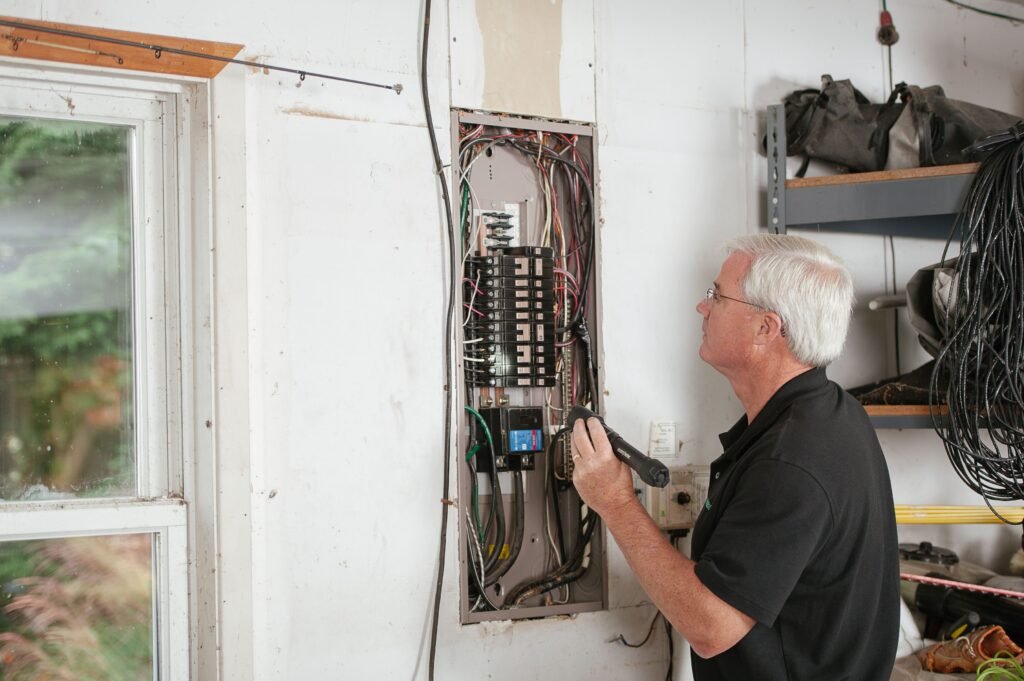
The wall behind or beside a washing machine is the most densely serviced wall in a home that is not a bathroom. In it, typically: two water supply lines running up to a recessed valve box, a standpipe and its trap carrying the drain, an electrical run for a dedicated outlet, and in many layouts a length of dryer duct. A 220-pound wall table is only rated at 220 pounds if its lag screws are in framing — and finding framing in that wall means driving a screw into the one cavity where a wrong guess is a supply line.
Three rules, in order.
- Use a stud finder with deep scan, and mark the valve box, the outlet and the vent hood on the wall first so you can see the services you already know about.
- Never mount within the vertical run of the standpipe or the supply box. The washing machine standpipe is a straight vertical line from the valve box area down to the trap, and it is exactly where you would instinctively put a table.
- Drill a pilot hole shallow, then deeper. If it goes soft, stop. A nicked supply line behind drywall is the slow leak you find six months later in the ceiling below; it is the same scenario as how to stop a washing machine flood, except that you built it yourself.
If you cannot establish what is in the wall, buy a freestanding table. It is the cheaper mistake.
Why a laundry folding table should not be made of wood
The laundry room is a humid room by design. Warm moist air leaves a dryer door every time it opens, a washer gasket holds water between cycles, and in a basement the room is cooler than the rest of the house, which means moisture condenses there first. The EPA’s household guidance on this is simply that mould needs moisture, and that controlling moisture indoors is the whole of the defence (EPA — A Brief Guide to Mold, Moisture and Your Home).
Particleboard and MDF in that room are on a clock. Water gets in at the cut edges and the screw holes, the board swells, the laminate lifts, and the top is no longer flat — which matters for a folding surface more than for a shelf. Solid timber does better but still moves, and an oiled or waxed top absorbs detergent splashes.
Stainless steel is the obvious answer and the reason the commercial prep table keeps turning up in laundry rooms: non-porous, wipes clean, does not care about a damp cloth, and no finish to lift. Two grades appear in this category. 430 is the common stainless for prep tables and is perfectly adequate indoors; 304 adds nickel and is the more corrosion-resistant of the two, which is worth having in a basement or anywhere with a salt tablet bucket nearby. Neither will rust in a normal laundry room.
The one real downside is noise. Buttons, zips and a wedding ring are all loud on steel. A folded towel left on the surface solves it and costs nothing.
Three surfaces, three rooms
Three pass this site’s selection rules — live listing, named merchant, real sales rank, genuine stock — and all three are stainless, deliberately, for the reason above. Two listings that passed the mechanical checks were left off: a pine-topped wall table, because solid wood in a humid room is the thing this page just argued against, and a two-tier basket holder sold under “laundry sorter” that is not a table at all and arrives without the baskets.
Garvee 48 by 30 inch folding prep table — the deepest surface here, and the default. 430 stainless, 48 inches wide and 30 deep, 36.6 pounds, with folding legs, an adjustable undershelf and levelling feet with non-slip pads. Garvee rates the top at 520 pounds and the undershelf at 400. The 30-inch depth is the reason it leads: a folded bath sheet sits entirely on the table with room to work, which no wall-mounted unit in this category manages. It arrives assembled and the legs fold flat, so it can live against a wall between laundry days. Rank 16 in utility tables. Check your levelling feet on a basement floor before you load the shelf.
Mioleu 48 by 24 inch foldable work table — the same idea for a narrower room. 48 inches wide by 24 deep, 31 pounds, with an adjustable undershelf and adjustable feet, rated at 520 pounds on the top and 400 on the shelf, and it unfolds without tools. Twenty-four inches of depth is the working minimum for towels and is six inches of floor you get back, which in a laundry closet is the difference between a table and no table. Rank 52. The polished top wipes clean, and the undershelf is the honest reason to prefer either of these two over a wall unit: somewhere for the baskets to go while you work.
CYGJSYEA wall-mounted folding table — for the room with no floor at all. SUS304 stainless, 39.4 inches wide by 19.7 deep, 12 pounds, rated at 220 pounds with a reinforced partition and a triangular support, and it drops flat against the wall on a release arm. This is the one to choose when the floor is fully occupied, and it is also the one where you get to set the height to suit yourself. Two conditions attached, both serious: the 220-pound rating assumes fixings in framing, not drywall anchors, and 19.7 inches of depth is adequate for towels and shirts but tight for bedding. Read the previous section before you pick up a drill. Rank 314, the most modest here, and 304 stainless is the better grade for a damp basement.
The readers who should skip the table entirely
If you have a side-by-side front-loading pair, you already own a folding table at roughly the right height and you should spend the money on something else. Put a thin mat or a folded towel across the lids and the job is done.
If the plan was to fold on the table and leave the pile there until tomorrow, a table will not change anything, because the creases set as the load cools regardless of what it is cooling on. And if the clothes are coming out of the dryer damp rather than warm, no surface helps — that is airflow, and it belongs with how to clean a dryer vent, not with furniture. One last category that does not want a table at all: knitwear dries flat on a towel and goes into a drawer folded, which is a bed or a rack job rather than a 30-inch steel top, as how to wash a wool sweater sets out.
FAQ
How high should a laundry folding table be?
Measure to the underside of your elbow with your forearm level and subtract about four inches. For most adults that lands between 34 and 39 inches. Commercial prep tables sit in roughly the right band; desks and most wall-mounted units are built at 29 to 31 inches, which is a seated height and uncomfortable to stand at.
How deep does a folding surface need to be?
Twenty inches is the minimum, 24 is comfortable and 30 is genuinely better. Fold your own largest towel and measure it — anything that overhangs the front edge slides off, which is the single most common reason a table goes unused.
Can I use a kitchen prep table as a laundry folding table?
Yes, and it is the most common solution for good reasons: stainless is non-porous in a humid room, the height is right for standing work, and the undershelf takes the baskets. Just check the grade — 430 is fine indoors, 304 is the better choice for a damp basement.
Are wall-mounted folding tables strong enough?
Their ratings are real only if the fixings are in framing. A 220-pound rating achieved with drywall anchors is not a 220-pound table. In a laundry room that framing search has to avoid the supply box, the standpipe and the electrical run, which is why this is the one shelf in the house worth being slow about.
Should the table go next to the washer or the dryer?
Next to the dryer, every time. The warm window after the cycle ends is short, and the whole value of the surface is being able to put a shirt down flat without walking anywhere.
Will folding straight from the dryer really stop wrinkles?
It stops them forming, which is different from removing them. Whirlpool’s position is that wrinkles form when a load cannot be taken out as the cycle ends, and that garments should be removed promptly. If you cannot be there, the tumble-after-drying option on most dryers buys you some time.
Measure your elbow, then check the wall
Three decisions, in this order, and the products come last.
Height first, because a table at the wrong height does not get used and the money is simply gone. Depth second, measured against your own folded towel rather than against a specification. Then, and only then, freestanding versus wall-mounted — and if the answer is wall-mounted, you have a wall survey to do before you own a table at all.
Of the three above, the Garvee 48 by 30 is where most people should start. It is the deepest surface here by six inches, it needs no installation, the legs fold when the room has to be a room again, and it has the strongest sales rank of the three. Take the Mioleu if 30 inches will not fit, and the CYGJSYEA wall unit if the floor is genuinely full — on the condition that you find the framing first and stay well clear of the valve box.
Then use it in the two minutes that matter. The dryer stops, you are standing there, and the shirt is still warm. That is the whole product.