Last Updated on September 2, 2026 by Umar Farooq
UE and Ub are the same code. Samsung treats them as one signal displayed differently depending on the model, so if you have been searching for the difference between them — there isn’t one.
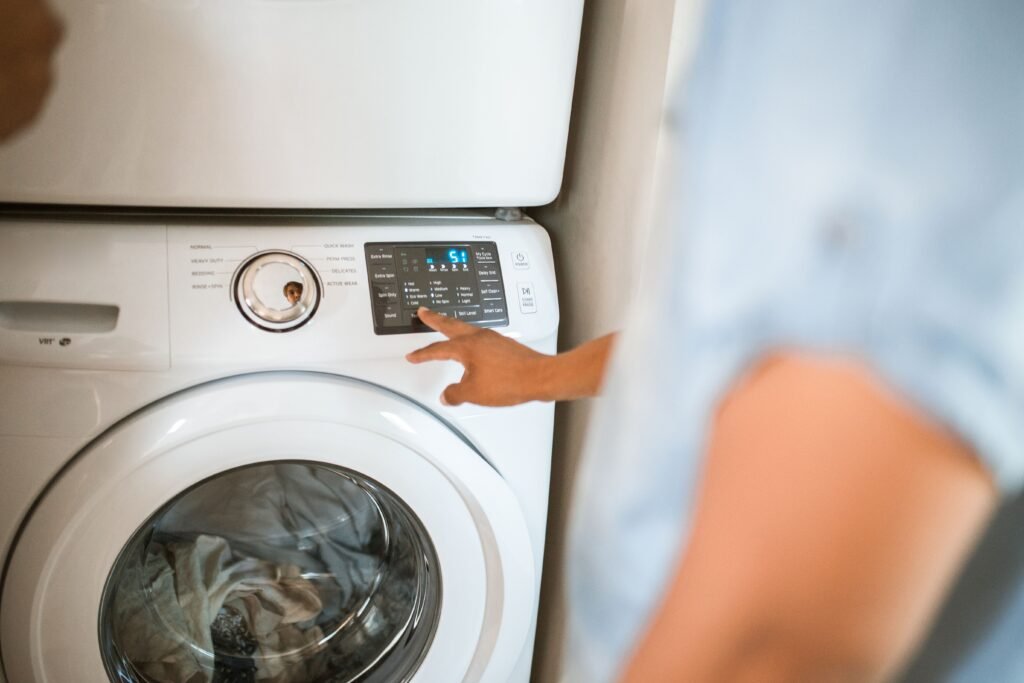
What the code means is that the washer detected an unevenly distributed load and stopped rather than spinning it. That is a refusal, not a failure. The machine checked, did not like what it found, and declined to accelerate a drum it could not balance (how to fix UE / UB error in Samsung washing machine).
The genuinely useful thing on this page, and the reason most people get this code repeatedly, is further down: Samsung documents specific weight limits for bedding, and they are far lower than almost anyone assumes. If you have been washing a full-size duvet in one go and wondering why this keeps happening, that is very likely your entire answer.
If you landed here from a symptom search rather than a code, washing machine shakes during spin is the broader version of this diagnosis.
What the Samsung washer UE or Ub error means on supported models
Before spinning, the washer checks whether the load is distributed evenly enough to accelerate safely. Uneven weight at spin speed produces forces the suspension was not designed to absorb, so rather than proceed, the machine tumbles to redistribute, re-checks, and eventually gives up and posts the code.
Samsung’s own troubleshooting for UE/Ub focuses almost entirely on load size, distribution and machine levelling — not on parts. That emphasis is a strong hint about where the answer usually lies.
Normal behaviour vs an actual fault
Close to normal: the code appears occasionally, particularly with a small load, a single bulky item, or bedding. The washer is doing its job.
An actual fault: the code appears consistently with a fair, evenly distributed, appropriately sized load — or on every wash regardless of what is in the drum.
The weight limits behind a Samsung washer UE or Ub error
This is the part worth reading twice, because it explains most repeat cases.
Samsung documents a maximum of 3.0 kg for bedding covers on top-load models, and 2.0 kg or less at up to 800 rpm on front-load models.
Put that in context. A full-size cotton duvet cover can weigh 1.5–2 kg dry, and a duvet itself considerably more. Wet, it holds several times its own weight in water. So a single item that looks like a modest load — one duvet, plenty of room left in the drum — can sit far outside the documented limit the moment water is added, while the drum still looks half empty.
That is why “but it wasn’t even a full load” is such a common reaction to this code. Balance is about weight distribution, not how full the drum looks, and a single heavy wet item concentrated on one side is the hardest possible thing to balance.
Before you test anything
- Model number and form factor — the weight limits differ between them.
- The exact code shown, and whether your manual documents a related code such as
Ur. Confirm against Samsung’s reference if unsure (Samsung washing machine information and error codes). - Exact cycle stage — does the code appear as spin starts, partway through ramp-up, or only at the highest speeds?
- Load condition — specifically whether a single bulky item was involved.
- Water remaining — mostly to confirm the machine had drained before attempting spin, since this code is about balance rather than drainage.
The safe checks
1. Redistribute, and respect the weight limits
- Open the door and spread the load evenly around the drum rather than leaving it bunched to one side.
- Wash a single heavy item with two or three similar-weight items rather than alone. A duvet cannot balance itself; a duvet plus towels usually can.
- Stay within the documented limits: 3.0 kg bedding on top-load, 2.0 kg at up to 800 rpm on front-load.
- Avoid mixing a few very heavy items with a lot of light ones — that combination bunches rather than distributes.
2. Level the machine
- Confirm all four feet make firm, even contact and the machine doesn’t rock when pressed at a corner.
- Samsung’s installation guidance: rotate the leg adjuster clockwise to raise a corner, anticlockwise to lower it, and keep roughly 10 cm of clearance from nearby walls.
- Tighten the lock nuts once level, or vibration will undo your work within weeks.
3. Run calibration if your manual documents it
On models that support it, calibration is typically run by pressing and holding Temp. and Delay End together for 3 seconds until “Cb” appears, then pressing Start/Pause (Samsung washing machine is shaking too much). This lets the machine re-learn what a balanced empty drum feels like, which matters if it has been moved.
4. Check the cycle selection
Mismatched cycle selection is part of Samsung’s own documented troubleshooting here — a high-spin cycle on bedding will trigger this far more readily than the cycle intended for it.
Stop-use warning: Don’t force the drum by hand or override the safety stop. If the machine rocks hard enough to shift position, or you hear grinding or banging rather than a simple rebalancing attempt, stop the cycle and unplug it.
Read your result
| What you observed | What it means | Where to go next |
|---|---|---|
| Code appeared with one bulky item | Expected — over the documented weight limit | Add companion items, respect limits |
| Fair balanced test load runs clean | Load-related, not a fault | Load habits |
| Machine rocks when pressed at a corner | Not level | Adjust feet, tighten lock nuts |
| Code returns on every load type, machine level | Suspension or vibration sensing | Service |
| Grinding or banging alongside the code | Mechanical | Stop — service |
| Machine physically moves across the floor | Different symptom | Walks during spin |
If the load is confirmed fair, the machine is level with feet secured, and the correct cycle is selected — and the code still returns — this has moved past load and levelling into the suspension or vibration-sensing system. That is behind panels not intended for routine access, and confirming it needs model-specific testing. Don’t use voltage or resistance values from outside Samsung’s own materials for your model.
Confirm the repair
- Run an empty spin first and confirm it completes without the code.
- Run a small, evenly distributed load of similar-weight items and confirm it spins fully.
- Work up to a full load over a couple of washes rather than jumping straight back to your heaviest typical load — that way you find the threshold rather than just triggering it again.
- Note whether the code returns only with specific item types. That is useful evidence either way.
When to book service
- A fair, evenly balanced test load still triggers the code on a level, calibrated machine.
- The machine shakes violently or physically moves rather than simply pausing to rebalance — see washing machine walks during spin.
- You hear grinding, banging or metal-on-metal during a spin attempt.
- You’re not confident accessing suspension components — they sit behind panels not meant for routine access.
FAQ
Is UE the same error as Ub?
Yes. Samsung treats them as the same unbalanced-load detection, displayed differently by model. The troubleshooting is identical.
My washer shows dC instead — is that the same issue?
Possibly. On some front-load models dC is used as an alternate display for the same unbalanced-load detection, rather than the door fault it usually means. See Samsung washer dC or dE error for how to tell them apart.
My manual mentions a separate Ur code.
Closely related but not identical. Some sources distinguish Ur as being about how the clothes are distributed versus Ub about the washer’s own balance — Samsung’s UE/Ub guidance doesn’t draw that distinction explicitly, so confirm against your model’s manual.
Does washing a single comforter almost always trigger this?
Often, yes — and the weight limits above are exactly why. A full-size item wet is well beyond the documented maximum, even when the drum looks half empty.
My clothes come out soaking wet after a cycle that showed this code.
Connected — a machine that reduces or abandons spin won’t extract properly. See clothes soaking wet after wash.
Will it go away if I keep restarting the same load?
Not reliably. If a specific load keeps triggering it, redistributing or reducing that load works; restarting and hoping does not.
I tried calibration and the calibration itself failed.
That shifts the diagnosis — a calibration routine that won’t complete is its own fault and needs clearing before UE results mean anything. See Samsung top load washer calibration failed.
The machine also shakes badly alongside this code.
Closely related — see washing machine shakes during spin for the broader vibration diagnosis.